
Thursday, 29 March 2012
Recording
Over the next few weeks I will be updating you with my works in progress. This is to reflect the continual process of painting in relation to tasks in the workplace. By the end I hope to have a large number of canvases to display, showing the repetition the two processes have in common.


New proposal
I've been re thinking my plan for the degree show. here is my section for the degree show group catalogue...
Rather than defining her art identity solely as a painter, Pip Preece prefers to be thought of as an arranger, a collector of thought processes and at times a narrator. However she still finds that the methods of painting allow her to express these mechanics most powerfully.
Preece translated the detachment of Manet’s bar maid at the Folies Bergere into her own scene of contemporary ennui.
Alongside her studies Preece has worked at a local off licence, giving her a sense of the ennui the contemporary workplace brings. The experience of menial activity influenced her to consider how in an environment of ennui one begins to see myopically, viewing aspects of the setting from a restricted viewpoint, rather than the wider picture. Tasks such as stacking shelves, serving customers, counting money and cleaning become second nature activities. These processes have infiltrated Preece’s studio practice.
The physicality of the nature of painting and time devoted to painting as an action reflect the working environment. By considering areas of the workplace and reducing them visually in terms of line, colour and angle, Preece shows how the mind simplifies its perception of objects one becomes over familiarized with.
The arrangement of mundane imagery creates a methodology of repetition; in both the production and presentation of this Preece hopes to reflect the repetitive process of menial labour.
Saturday, 10 March 2012
David Fulford
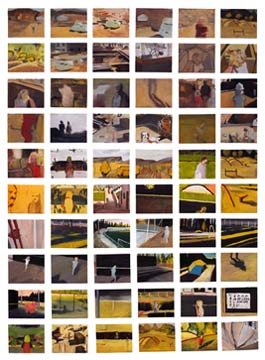
David Fulford is an artist I became aware of at the last Liverpool Biennial. He exhibited this piece 'Near The Site' at the Walker Art Gallery for the John Moores Painting Prize. Although the concept behind the work is totally different to my own I really enjoy the layout and presentation of the small canvases, and was wondering whether to attempt something similar for the degree show. By presenting a number of paintings of my workplace in this way a methodology of repetition, compositionally, pigment-ally and subjectively. This repetition I hope will reflect the repetition of the act of working in such a place.
Bruce Nauman
To me Bruce Nauman is the King of video installation. Particularly his 'Feed Me' piece and 'Clown Torture'. There is something about their set up that absorbs their whole environment. I will certainly be considering Nauman's practice when making the decisions for the presentation of my own films.


Edward Hopper
It might seem an obvious place to start, but I've been considering the work of Edward Hopper to get a better understanding of the tensions betwwen charaters and sense of ennui in his work.


Friday, 9 March 2012
Gregory Crewdson
I really like Gregory Crewdson's cinematic photography. There is something about the eerie familiarity of his work that really appeals to the story teller in me. I want to create a narrative for myself. Its amazing how he can achieve so much in just a single shot. Its a scene but it has essences of the pre scene and keeps us in suspense about the post scene. I think a lot of it is down to the camera angles and lighting, something I would like to develop in my own work.


the STOP and THINK post (traumaticstress)
I have been rethinking what my project is at this moment in time and what I want it to be.
Since the last presentation I have been considering ways to move my project forward. I've had the artists' equivalent of writers block. Everything I've been doing has been strained, forced and quite frankly unnatural! and you know... I had been convincing myself that it was vanity, that I fancied myself as a painter and that I was being stubborn by not moving to another medium. But actually when I REALLY think about it its not that at all! It's not a matter of it being, vanity, stubbornness or that fact that other media are 'out of my comfort zone', it's actually the desire for my work at the degree show to reflect my identity as an artist so that, in some way, visitors of the show will leave knowing me (through my work) a little better.
Now you might say, 'THAT IS VANITY!'. I disagree. Vanity would suggest I wanted people to look favourably at me, that I wanted to show off in some way. Not at all. I want people to see my work and what I produce in a realistic way. Thats how they'll know me. and If they like it then thats a positive, but if they don't I'll still be happy because at least I've produced something that reflects my practice openly and honestly.
My work has been through a few twists and turns over the past few weeks. Thats part due to a lack of confidence, and part due to the fact I don't really know what direction to move in and part because of the combination which I was referring to as writers block before.
I was recently lucky enough to have a one on one meeting with a very successful artist, James Iverson, who really picked me up and gave me some inspiration. But I'll save that for the next post.
Homeland Exhibition
So much for not neglecting the blog!!
It seems that since I've been carrying my journal round with me everywhere that I've found a new way of collecting thoughts. Perhaps this can be a positive thing for the blog though. Rather than blathering on at you about where I ate my lunch and that pair of shoes I saw in a shop down chapel street I can get down to the nitty gritty of my art practice on here.
I was recently involved in an the 'Homeland' exhibition at the Woltenholme Creative Space, a derelict building in the centre of Liverpool ideal for an unconventional student exhibition.
The Exhibition at Wolstenholme gave me the opportunity to think more critically about my work and how it could adapt to a space.
I decided to embrace the differences between the unconventional space and what my work was trying to achieve (updating past works).
I decided to create a juxtaposition between the traditional gilt frame and the unconventional rustic gallery wall, giving a jarring sense of contemporary versus historic and questioning traditional methods of display.
I had been working on a recreation of a gallery space online to investigate digital media (I refer to this later). I wanted to find a way of bringing the idea of technology based art into the gallery, however I dismissed the concept of bringing the Internet into the space on the basis that it is such a free wide source of information that it seemed /contradictory to confine it within a gallery space.
At around the same time I became interested in Hockney’s work. He is predominantly a painter however his work has strong connections to technology and the manipulation of photography. Recently he has developed an obsession for the iPod and iPad using apps to create beautiful digital images, which he continues to refer to as paintings claiming the iPad to be just a new medium of painting.
He also uses this technology TO DISPLAY THEM! Now although unlike Hockney. I couldn’t afford 40 iPads, I still wanted to show how digital media affects our perception of art.
It led me to consider showing my works on digital photo frames. These gave me the opportunity to digitally manipulate the paintings I had already produced to create over 50 new digital paintings.
My little attempt at Mass production
Which Walter Benjamin claimed ‘contributed to human emancipation by promoting new modes of critical perception.’
By editing my own paintings on the digital frames I attempted to create new digital paintings. As Benjamin said, they retain their ‘underpinnings in the ritual in which …’ they had their ‘…original initial utility value’. So although they have been manipulated they can always be related to their traditional origins. The images are not obviously recognizable, the hues, angles, cropping and scale have changed. In doing this I hope they can be appreciated for their refreshed aesthetic and show the progression of display.
I hope the digital paintings allow the viewer to recontextualize the works.
Separately they give a sense of the original paintings but the initial aura is lost in the medium of digitalization and editing. This presents the power digital media has to change our perception of art works.
By presenting them in a line the viewer has the choice of viewing one unit from close up, and seeing the others in their peripheral viewpoint or standing back and seeing all 9 digitally flickering , creating an area for contemplation of the process and effect of digitalization.
I began to think about how my work could be positioned in a relevant way. I wanted my work to question the values of reproduction in relation to the original by displaying the two in close proximity.
The theme of the exhibition Homeland was rooted around the idea of territories. This led us to decide to separate the themes of the rooms to home and land.
Home was a warmly lit room, with Lucy Somers’ furniture installation giving an air of comfort and Dave Whiteley’s ‘Check-mate’ performance piece welcoming you to interact. This is the place where my traditionally inspired paintings would work best, by juxtaposing the gilt frames with the crumbling walls. Old versus new.
And Land. A more clinical experience. This space was occupied mainly by wall based works and technological works. The synthesized music from Matt Weir’s ‘Phantom’ film and the eerie glow of Dave Whiteley’s floor projection gave a sense of the contemporary. This colder digitalized space. was An ideal location for my Digital Photo frames.
By placing the two forms of work in different territories their competition is emphasized. However the two can be viewed as a single entity through the doorway. Their separation between territories experiments with the tensions of their aesthetics, forcing us to appreciate them for their differences, however their visual and distal-unity again encourages the viewer to question the effect of mass production and the alterations that occur during this process.
Finally I began to consider how my work reacted with the work of other artists, mainly Lucy Somers’.
Both our work embraced the concept of territories having works in both rooms, so we tried to subtly create an interaction between our works. For example the wine bottles in front of the Folies Bergere or the play on light and shadow to emphasize the digital glow of my photo frames against the more homely yet purposefully inharmonious installation. I wanted my frames to show the coldness of the digital works and Lucy wanted her work in Land to appear out of context. By intertwining the two it made our arguments seem more valid.
Also the Young man looking out of his window was placed in a relevant position, the window between the two rooms. The painting is about technology-enforced isolation. Is he connecting the works between home and land by looking through the window or idly gazing into his iPod, separating the digital from the traditional completely?
I extended my work to a further level by testing the concept of a performance piece. I stood by the bar, which was in position to see both the painting of the Folies Bergere and myself reenacting my painting. To critically evaluate the piece it was not so effective in the bustle of the exhibition, and the detachment of the original was difficult to convey. Most of the audience failed to notice the performance.
I made the decision to enter one of my Remakes into the John Moores painting prize. If accepted it will show how a painting directly inspired by another (technically a reproduction) can be considered for its new purpose.
Monday, 30 January 2012
Websites!!!
Recently I've been neglecting the old blog a bit. (sorry blog!) It's because I've been working on my concepts, an exhibition and also a couple of websites. If you're interested in what my work is about then take a look at
www.pippreece.weebly.com
or
www.virtuallyatthetate.weebly.com
and I promise to return for more blogging adventures soon :)
www.pippreece.weebly.com
or
www.virtuallyatthetate.weebly.com
and I promise to return for more blogging adventures soon :)
Sunday, 13 November 2011


Friday, 30 September 2011
Stand Still
Okay, so after the bold street festival things have come to a bit of a stand still. I've been planning and pondering over these paintings and how they will be set out and the only thing holding me back is the photography. At this moment in time I'm wishing I had chosen an easier subject matter. Something that would be constantly there for me to come back to and work from, but no, I do want a challenge. And challenge this is. I've been reading up on each of the paintings I plan to 're-make' so my contemporary works are as true to the originals as possible, however all this planning and pondering has left me with no real creations for myself. I know it's only the second week in but I already feel like I'm falling behind. I have plans for photo shoots starting tomorrow in different locations however right now I think I need to produce some sketches, or reinterpretations from the original images. So off I go... wish me luck!
Wednesday, 28 September 2011
Bold Street Festival
This Saturday 24th September was the Bold Street Art Festival and the art lids had a fanstastic day, work wise and commercially.
First things first, we have Antonia Jones to thank for the whole thing as she did an amazing job of getting us into Ropewalks Square for the day. Becky set up a table with clay and tools for the children of Liverpool to get involved in as she worked alongside them. Louise worked the longest of all of us doing incredible free portraits for the public. I really liked Anna's lovely silk screen printed labels depicting sections of bold street pinned them to passers by. Lucy and I worked on a collaborative piece on a large felt covered wooden board. We used some works by Degas as inspiration. I guess you could say we were creating 'remakes' of his work (hehe had to fit that in).
I think what made our work so successful was that we were constantly involving ourselves and communicating with each other about what we wanted next from the painting. In this respect I think we have both impacted on each others practise. I certainly have learned to consider the effect of colours on each other much more.


First things first, we have Antonia Jones to thank for the whole thing as she did an amazing job of getting us into Ropewalks Square for the day. Becky set up a table with clay and tools for the children of Liverpool to get involved in as she worked alongside them. Louise worked the longest of all of us doing incredible free portraits for the public. I really liked Anna's lovely silk screen printed labels depicting sections of bold street pinned them to passers by. Lucy and I worked on a collaborative piece on a large felt covered wooden board. We used some works by Degas as inspiration. I guess you could say we were creating 'remakes' of his work (hehe had to fit that in).
I think what made our work so successful was that we were constantly involving ourselves and communicating with each other about what we wanted next from the painting. In this respect I think we have both impacted on each others practise. I certainly have learned to consider the effect of colours on each other much more.


Tuesday, 27 September 2011
The Remakes
Over the past few weeks I have been considering which paintings to use as inspiration for the 're-makes'. I have made the decision to reference well known works of art which are easily recognised by their composition or subject. This is because I want my work to have the essence of the original, and to be recognisable to some level. In saying that, they need to be works that can be recreated in a contemporary manner.
Here are a few pieces I am considering.
 |
| 'Un bar aux Folies Bergère' Manet |
 |
| 'Young Man At The Window' Gustave Caillebotte |
 |
| 'Luncheon of the Boating Party' Renoir |
 |
| 'Nighthawkes' Edward Hopper |
 |
| 'The Student' Thomas Burke |
 |
| 'The Alforni Portrait' Jan Van Eyck |
I have been considering how to change these iconic paintings in a ironic and possibly humerous yet in a tasteful way. Although I will be depending on models to pose in set conditions the trick will be for my work to still appear natural and not contrived.
Thursday, 22 September 2011
Plan
I have put a print out of this in my studio space, but just incase you've missed it, and have an interest in my work, here is my basic third year plan.
Pip Preece’s 3rd Year Plan
The contemporary is derived from its traditions, so my work takes the past and creates new meanings and avenues.
By looking into the work of certain past artists I have gained an interest in the concept of their reconstruction of art works in a contemporary manner.
The re -make.
The remake can be any medium in which that said artist believes a previous piece can be reproduced in a contemporary manner. All art is a reaction to an experience, but the re-make is specifically a reaction to an experience of ART.
Paula Rego, Sebastian Schrader and Francis Bacon, whether directly or indirectly, have all produced re-makes. Bacon’s reworking of Velazquez’s ‘Pope Innocent X’ is the most direct. He has continued with the medium of oils, and the essence of the composition and subject is fundamentally the same. However there is a power shift in the contemporary piece. The ideology of spirituality has a stronger presence in Bacon’s work, and thus gives a new contemporary connotation to the work.
Rego’s humorous adaptations of Disney’s Snow White are another example of such re-makes. She has twisted the childlike innocence of the character and used the fairytale only as a thin guise for psycho-sexual intrigue and taboo, giving the story a more mature, sexual edge, through a feminine view point. Her choice to alter the medium from animation to oil paint also shows the transition of the tale from childhood to maturity.
Schrader’s initially classical looking paintings are in fact possibly the most contemporary paintings. He associates his work with an ongoing philosophical-psychological investigation of familiar myths and histories. By referring to art historical motifs and subjects with the gesture of painterly perfection, he reflects on the contemporary role of the artist and painting as well as current issues.
This year my work will take the remake into consideration. Past works will inform my practice and be revised to generate contemporary art with its roots firmly in the traditions of painting. I will be working with the medium of oils, in order to continue the traditions of the originals, and to hold tight the relationship between the two.
My plan for my work is not solid, as I have not yet selected which paintings to take into consideration, however I do have some visions for possible directions.
I will be working from photographic imagery most likely posed in set conditions utilising people I am familiar with, but will also use news photography as a reference where required. My work will make statements about contemporary society with a humorous undertone.
At this stage I do not see any need to focus on the work of a single artist, but plan to use several familiar pieces of art as inspiration. In that way my work will have an instant impact, rather than alienating viewers by forcing jargon on them. It is my strong belief that art should initially be visually initially, and then the option of further research and information should be a secondary element.
Friday, 9 September 2011
Art Lids
I feel so excited after yesterdays meeting with the Art Lids. I don’t know what to say! It was great to buzz ideas round and to find out everyone’s plans. I’m really looking forward to producing a mural with Rose and Lucy at the Bold Street Art Festival on the 24th September. Antonia has even managed to organize us a shop this November in Clayton Square. The theme will be ‘Alice in Wonderland’ which is a very exciting prospect, and I can’t wait to get started on some work for that!
I have volunteered to be the publications organizer, and so I have been working on finalizing our logo and brochure. Here are two examples of logos which have been put forward to the Art Lids group.


The Art Lids Group is something that is really pushing us to improve ourselves as commercial artists, allowing us to exhibit, advertise and sell our work together, and I am really enjoying working with such a great group of enthusiastic people and friends.
Tuesday, 19 July 2011
ROYAL ACADEMY- Summer Exhibition
As much as I have read about and talked about it, I have never had the chance to visit the Royal Academy during the Summer Exhibition season before. So it was with much excitement that last week I finally got the chance to go.
And was I disappointed?... pfffftt NO! It was a fabulous experience!!! The rule ‘art is always better in real life’ is even more true when considered with an exhibition that relies so heavily on its curation. I’m not saying that the work wouldn’t work on its own, of course it would, but when all the works were combined in a room, wow! JUST WOW! The summer exhibition is a truly unique phenomenon, whereby art, curator and curation and the work of established, unknown and emerging artists really can interlock successfully.
The first room, Wohl Central Hall we were immediately met by a large Cindy Sherman piece ‘Untitled # 472’, Martain Creed’s ‘Work no.998’ and Garry Fabian Miller’s ‘Cobolt (IV)’. So even from the first room there was a wide variety of media, techniques and styles.
I am never one to say ‘I don’t like a piece of art’. I try to understand what it is about first. Contemporary art often needs a bit of reading up on afterwards, and Miller’s digital C-type print ‘Cobalt (IV)’ was one of those works. He has specialized in producing ‘camera-less’ photographs the 1980’s. He works in the darkroom, shining light through coloured glass vessels and over cut-paper shapes to create forms that record directly onto photographic paper. This gives his work a very unique quality. The large print was reminiscent of Rothko’s abstract works, however the medium gave it a much flatter plasma-screen appearance.
Christopher Le Brun said, ‘there are two ways of showing paintings, and one is the classic orthodox hang with lots of space around every single piece. But here it’s like a battle of the paintings – forty big pictures on one wall alone!’. And yes, the variety of works in the exhibition was immense. The combination of famous and up and coming artists was very unusual but effective. I must say how honoured I felt to see the work of one of my idols, Jenny Saville. I always knew that Saville’s canvases had to be seen first hand because her painterly technique is so important to her and so it was great to be able to get close and inspect each brush stroke, which was beautifully precise yet fluid.
I could write so much more about the summer exhibition. It was a fantastic chance to become aware of new artists, and I certainly have a long list of them to inspire me.
Monday, 18 July 2011
Edinburgh College of Art Degree Show 2011
When visiting Edinburgh in June, I took up the opportunity to visit the ECA Degree Show. And my goodness was I impressed!!
Although my main interest was the Fine Art Department, Animation has always been of interest to me and so I had a good look around their department too. It was a real treat to watch ECA student Paul Rice’s advanced CGI animation ‘Let Me Come In’ which just so happened to be nominated for the Edinburgh International Film Festival also. The twisted version of the fairytale ‘Three Little Pigs’, although disturbing was very captivating. I particularly enjoyed Will Anderson’s humorous yet more traditional animation ‘The Remaking of the Longbird’ and have been following his website www.whiterobot.com and other animations ever since.
There was much to be seen in the Fine Art Department, what, with it being the Degree and MFA shows at the same time, and I found it a very enlightening and really inspiring experience.
Of course if you know me at all you know that I love to see where contemporary painting is going. The ECA show was no exception. I loved it! There were many students both post-grad and masters practising painting.
I absolutely fell in love with the exquisite paintings and photography by Anna Bernard. She made use of the natural colours of the wood, which she painted onto, and complemented them with her own colours beautifully. This also happened to link into the subject of her paintings. When speaking to her she told me that the wooden barn she had painted was her own at the parents home. Her work explores the comfort of her country farm home now that she lives in the inner city.

Kari Adams’ series of paintings really caught my attention. She sees herself as an ‘artist who appropriates ‘things’ and products- taking them from their convivial structure, rearranging their anatomy.’ To place meaning within the new form. Her innovative use of combining canvases and using them in an unconventional manner really pushed forward her aim to create new forms and images with discordant texts.

The inventive style of drawing by Thomas Adam was really interesting too. Although the pieces where essentially 2 dimensional their placement around the room, occasionally with props made them work on a sculptural level. I found this quite fascinating.

Don’t get me wrong though. It wasn’t just the painting and drawing that interested me. Fiona Crozier’s work was ‘a series of events in which the viewer was not invited to watch.’ It consisted of earwigs trapped in glass fronted boxes and meat knives. The work had a powerful and shocking effect which pin pointed the irony, fragility and transience of life. She summed up her work with a simple quote ‘Bodies are only empty vessels, ain’t nothing in them. I’m not doing anything wrong.’ Ed Gien 1906- 1984.


Another aspect which added to the professionalism of the students’ work, is that the majority had personal statements, business cards and even had designed their own websites and online galleries. I would really like to be able to achieve this by next year too.
Every aspect of this degree show was exceptional! The work spoke for itself, and the students excelled!
Monday, 11 July 2011
Liverpool John Moores Graduate Show 2011
Well Mr Blog, it’s been a while. I’ve been off gallivanting round the country enjoying being a student on holiday (and looking at lots of art exhibitions of course) and now that I am back I think it’s time for me to stop neglecting you. We’ll have to do some back tracking first I’m afraid though, before I forget everything that I must tell you…
I think I will begin back in May, with the Liverpool John Moores Graduate Show, which definitely gave me food for thought. There was a wide variety of work in different media; sculpture, installation, films. There was also the special honour of having the help of Lorenzo Fusi (curator of the Liverpool Biennial 2011) to curate the exhibition.
The evening of the exhibition was buzzing. It was fantastic to see so many people taking an interest in the show! And the new arrangement of the Fine Art Studio really worked to give each piece its own viewing space. Fusi clearly had a lot of input in the development of the works and created a very simplistic and effective floor plan. My only criticism would be that the lack of labelling of the works and rule against business cards, may have been detrimental to the main purpose of the graduate show. In my opinion it should have been an opportunity for people to discover new upcoming artists from Liverpool. A graduate show is not only the marking of the end of a university course, but also a spring board to the new level of professionalism. As a JMU student myself, even I had difficulty deciphering whose work was whose. On later conversations, I discovered that this was a fear of some of the students, and yet it was missed. On a very serious note, as a student next year I hope to be very much involved with the show, and feel that this lesson needs to be learned by myself and by others in this upcoming year.
On saying this I otherwise felt optimistic about the growth of the John Moores Art Department. The multitude of work sited in all areas of the building was inspiring. From the Fashion Studios, to Interior Design and Fine Art, there was something to evoke a feeling of pride and excitement in all the people who visited.
On entering the Fine Art room visitors were instantly confronted by a collection of CCTV cameras and the sight of themselves on a screen. This gave the viewer a feeling of invasion or intrusion of their personal space, an uneasy impression of ‘Big Brother’.

A sculptural piece I particularly admired was a group of drawers, each filled with new and old make-up each with a description such as, ‘imperfect’, ‘used’, ‘salvaged’, which can, in turn be used as a metaphor to describe the women who have used such products. More pressure on women again? Still going to wear my make-up tomorrow though.

The interactive wall, where visitors were encouraged to write their feelings was predictable, as per Renshaw Street. It is all too easy for people to use this vehicle of expression for cheap comments and not in a serious, artistic context.

I must mention that, as a painter, I was disappointed by the lack of paintings in this particular show. I often worry to myself that painting becomes overlooked as a contemporary art form with the arrival of such technologically advanced media. But there is plenty of time to discuss this in a later blog.
Thursday, 19 May 2011
The Blog About Blogging
In the days before the blog I used to keep notes, newspaper articles and web addresses in sketchbooks, which would often end up being forgotten about at the end of each project. The blog is a tool that has allowed me to multi-task, gather thoughts and look back on things easily.
I will admit, at the beginning of the year I thought the idea of writing a blog regularly might begin to be a chore and another aspect of life to disjoint my work, however I've found that it allows me to record, reflect and revise my own work and the work of others in a professional manner. I guess I should just admit that I've got the blog feeeva!
I have used the blog in a number of ways...
- To question and move forward my own practice.
- To review how other artists develop their own practice. How this affects their work. How I can move my own work forward.
- To reflect on exhibitions of others, such as the biennial, student exhibitions, other exhibitions I have attended.
- To encourage fellow students and congratulate them on their work.
- To blog about my professional progression and exhibitions.
- To gather and hold information about artists of interest to look back on in the future.
- To present my thoughts to others.
- To articulate my opinions and act as a catalyst for ideas and brainstorming.
I have also really enjoyed the blogging community. I follow a number of other young artists' blogs and it is incredible the amount of information that this small group produces. In my view it is important for creatives to communicate, possibly even more so after university and so I plan to continue blogging next year and certainly after life at LJMU ... (but I don't want to talk about that right now because the thought upsets me.)
Wolstenholme (15th – 16th March 2011)
It has been a few weeks since the Re:Action exhibition at Wolstenholme by Anna Mulhearn, Dave Whiteley and Catherine Rockwood but I wanted to take a minute to look back on it.
I've never been to an exhibition in a gallery space dedicated to performance pieces. Normally I just seem to come across them in the public eye. But by having three performances in the same gallery it created a really buzzing, social atmosphere.
The first exhibit I was introduced to was Dave Whiteley's 'Relational Aesthetics'. He and another performed an endurance piece across a long dinner table, staring at one another whilst chewing gum. As the night went on, wine glasses were filled with excess saliva from this process. I found it quite a difficult piece to watch, as I not only felt that I was intruding on a private moment but also the act of spitting into the glasses made me feel uneasy. Perhaps this was to express a strained relationship and the awkwardness of the meal. I feel that this feeling of unease, and the format in which it was produced, made it a very powerful and engaging piece of work.
Next I viewed Catherine Rockwood's film and performance 'Modern Sexism'. The film was an updated version of Judy Chicago's 'Cock and Cunt' play. In Rockwood's adaptation there is a male playing the role of Cock. Both Cock and Cunt wear make up, which is said to represent the mask of the modern woman, and and tights over their heads which symbolise the new restraints and pressures placed on modern women. Along side this Rockwood repeatedly applied and removed makeup enforcing the ideas of pressures on women from the media. I really enjoyed this piece as we had been attending the same tutorials, so I had the chance to see her work develop throughout the year. Although her work had a humorous undertone, the reality of modern sexism really rang home when I was faced with the piece as a whole.
Last, but not least was the 'Forged Histories' performance by Anna Mulhearn. Again I had been lucky enough to see Mulhearn's complex piece develop throughout the year, and was thrilled to see the final piece. The setup reminded me of a theatre performance, with angled lighting and Anna placed in an armchair, forging documents. On a plinth at the side of the room was a photo album belonging to the family Anna had been researching intensely, which Anna had cleverly edited herself into. Muhearn had also managed to forge herself into a short film of a family holiday. I think the combination of all these aspects made the piece so believable. I wonder what the reaction of the family would be? Maybe one day we will find out.
The exhibition ended at the bar and curry stand... What more could you want from an exhibition!? It really extended the idea of social activity and art coinciding and completed the exhibition in a very pleasant and complementary way. Thumbs up!
I've never been to an exhibition in a gallery space dedicated to performance pieces. Normally I just seem to come across them in the public eye. But by having three performances in the same gallery it created a really buzzing, social atmosphere.
The first exhibit I was introduced to was Dave Whiteley's 'Relational Aesthetics'. He and another performed an endurance piece across a long dinner table, staring at one another whilst chewing gum. As the night went on, wine glasses were filled with excess saliva from this process. I found it quite a difficult piece to watch, as I not only felt that I was intruding on a private moment but also the act of spitting into the glasses made me feel uneasy. Perhaps this was to express a strained relationship and the awkwardness of the meal. I feel that this feeling of unease, and the format in which it was produced, made it a very powerful and engaging piece of work.
Next I viewed Catherine Rockwood's film and performance 'Modern Sexism'. The film was an updated version of Judy Chicago's 'Cock and Cunt' play. In Rockwood's adaptation there is a male playing the role of Cock. Both Cock and Cunt wear make up, which is said to represent the mask of the modern woman, and and tights over their heads which symbolise the new restraints and pressures placed on modern women. Along side this Rockwood repeatedly applied and removed makeup enforcing the ideas of pressures on women from the media. I really enjoyed this piece as we had been attending the same tutorials, so I had the chance to see her work develop throughout the year. Although her work had a humorous undertone, the reality of modern sexism really rang home when I was faced with the piece as a whole.
Last, but not least was the 'Forged Histories' performance by Anna Mulhearn. Again I had been lucky enough to see Mulhearn's complex piece develop throughout the year, and was thrilled to see the final piece. The setup reminded me of a theatre performance, with angled lighting and Anna placed in an armchair, forging documents. On a plinth at the side of the room was a photo album belonging to the family Anna had been researching intensely, which Anna had cleverly edited herself into. Muhearn had also managed to forge herself into a short film of a family holiday. I think the combination of all these aspects made the piece so believable. I wonder what the reaction of the family would be? Maybe one day we will find out.
The exhibition ended at the bar and curry stand... What more could you want from an exhibition!? It really extended the idea of social activity and art coinciding and completed the exhibition in a very pleasant and complementary way. Thumbs up!
Subscribe to:
Posts (Atom)